Venue Lead Management: A Practical Guide for Event Venues
Venue lead management is the process of capturing every event inquiry in one place, replying fast, qualifying the lead, booking a site tour and following up until the lead books or clearly says no, with every step tracked so nothing slips. For event venues and hotels with event spaces, it comes down to five stages (capture, respond and qualify, tour, follow up, close) and a few clear rules: who owns each lead, how fast it gets a reply, how many follow-ups it gets and what counts as lost. This guide gives you that process, a one-page lead management SOP you can copy, and the weekly review that keeps it honest.
Venue lead management is the process of capturing every event inquiry in one place, replying fast, qualifying the lead, booking a site tour and following up until the lead books or clearly says no, with every step tracked so nothing slips. For event venues and hotels with event spaces, it comes down to five stages (capture, respond and qualify, tour, follow up, close) and a few clear rules: who owns each lead, how fast it gets a reply, how many follow-ups it gets and what counts as lost. This guide gives you that process, a one-page lead management SOP you can copy, and the weekly review that keeps it honest.
Why venue lead management breaks down
Most venues do not have a lead problem. They have a handling problem. Inquiries arrive from your website form, email, phone, text, The Knot, WeddingWire, Zola and referrals, and each one lands somewhere different. On a busy event weekend, the team is running the floor, not the inbox. A couple who inquired Friday night hears back Monday afternoon, after they have already booked two tours elsewhere.
Three leaks cause most of the damage:
Slow first response: Planners and couples contact several venues at once. The first clear, helpful reply usually earns the tour. See our guide to wedding venue speed to lead.
Follow-up that stops after one try: A lead goes quiet, nobody circles back, and it is forgotten. Quiet rarely means no. It usually means busy.
No single source of truth: When inquiries live in personal inboxes, marketplace dashboards and sticky notes, nobody can see what is open, who owns it or what was promised.
The five stages of a venue lead
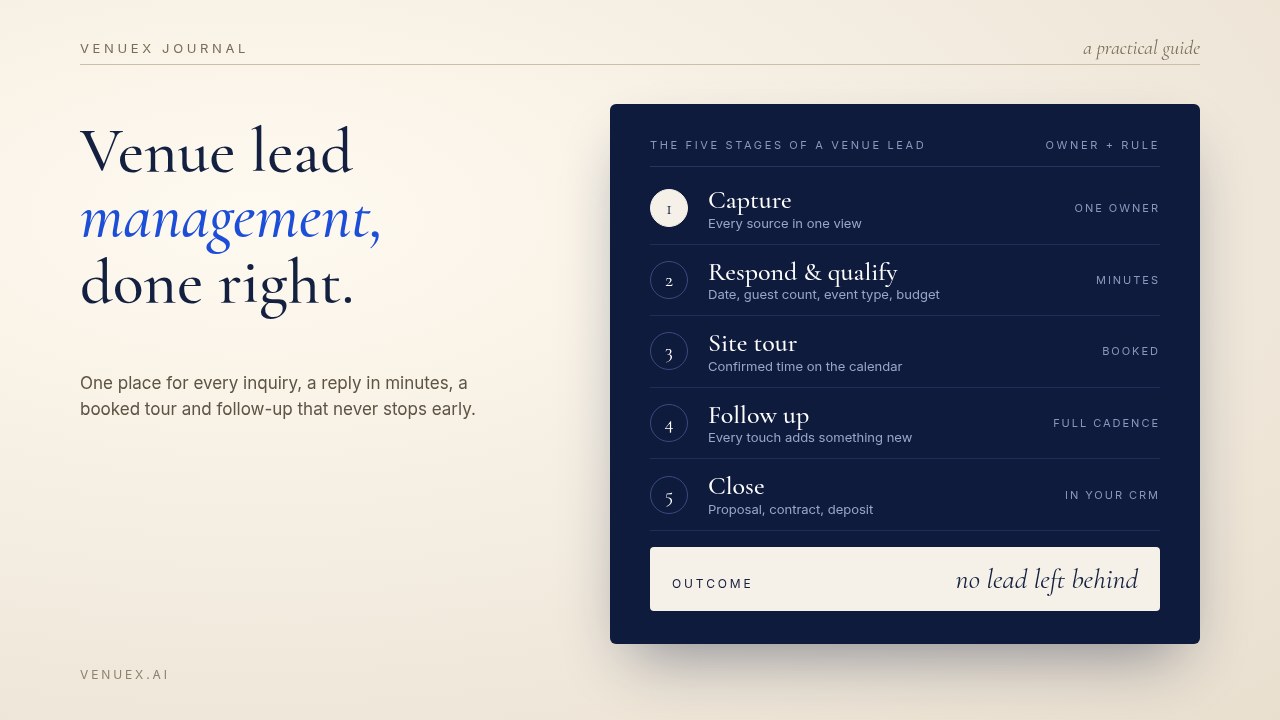
Every booking moves through the same five stages. Give each stage a clear definition of done, so a lead only moves forward when the prospect actually takes a step, not when someone feels optimistic.
Capture. Every inquiry, from every source, lands in one system with its date, guest count, event type and source attached. Done when the lead exists in one place with an owner.
Respond and qualify. A real answer to their question, plus the few details you need: preferred date and flexibility, estimated guest count, event type and a budget range. Done when you know whether the date and space can work.
Tour. The goal of every early conversation is a booked site tour or a call. Done when a specific time is on the calendar and confirmed.
Follow up. Most bookings take several touches, before and after the tour. Done when the lead books, picks another venue or asks you to stop.
Close. Proposal, contract and deposit, handled in your CRM. Done when the contract is signed and the deposit is in.
Hotels and multi-space venues should run separate tracks for weddings, social events and corporate groups. A corporate planner needs a fast proposal and room block details. A couple needs time, a tour and a few gentle nudges. Same five stages, different pace.
A one-page venue lead management SOP you can copy
Write these rules down and share them with everyone who touches a lead. Adjust the numbers to fit your team, but make sure every rule has a number.
Ownership: Every new lead gets one named owner within the hour, by event type, property or rotation. If you run several spaces or properties, see our guide to lead routing for teams and properties.
Response standard: Every inquiry gets a real first reply within minutes, including nights and weekends, not just an autoresponder.
First reply content: Answer their question, confirm date availability if you can, share the relevant pricing range and offer two or three tour times.
Qualification: Ask for date, guest count, event type and budget range, spread across the conversation rather than in one long form.
Follow-up cadence: At least five touches over about three weeks across email and text, each one adding something new, such as a photo, an open date or a package detail. Our follow-up strategies guide has ideas for each touch.
Tour confirmations: Confirm every tour right away, remind the day before and send a short note the morning of.
Lost rules: A lead is marked lost only after the full cadence, with a reason: date taken, budget, capacity, chose another venue or no response.
Handoffs: Anything involving custom pricing, date holds, buyouts or contracts goes to a person, with the conversation history attached.
See it live
Want to see how VenueX can do this for your venue?
Book a demo and watch VenueX reply to inquiries in about 10 seconds, follow up, and book tours on your calendar, trained on your voice.
You cannot manage what you cannot see. Before you tune scripts or cadences, get every channel into one view. Marketplace leads are the usual gap: inquiries from The Knot, WeddingWire and Zola often sit in separate dashboards and get slower replies than website leads. Our post on one inbox for The Knot, WeddingWire and Zola leads walks through the setup.
Your CRM, whether that is Tripleseat, HoneyBook, Event Temple or another system, should stay the record for proposals, contracts and event details. If you are still choosing one, read choosing the right CRM and lead management setup for event venues. This guide is about the process you run on top of whatever system you use.
Run a 30-minute weekly lead review
A process only works if someone checks it. Once a week, the sales lead or GM should review:
Every lead older than 48 hours with no reply, and why.
Every lead that went quiet mid-cadence, and the next touch planned.
Tours booked this week, and how many came from each lead source.
Leads marked lost, with reasons, to spot patterns like pricing or capacity.
The hardest rules in the SOP are the ones that depend on someone being available: replying in minutes at 11pm, following up five times without forgetting and booking tours while the team is running an event. That is where an AI sales agent helps. It handles the first touches on every lead, and your team takes over for tours, proposals and closing.
VenueX is an AI sales agent built for event venues and hotels with event spaces. It is not a CRM. It replies to new inquiries in about 10 seconds, 24/7, by email and SMS, and the same agent runs your website live chat. It answers from a knowledgebase your team approves, qualifies each lead, books tours on your connected calendar and follows up automatically when leads go quiet. VenueX works alongside Tripleseat, HoneyBook and Event Temple, plus Gmail, Outlook and Google Calendar, and brings in leads from The Knot, WeddingWire and Zola. Venues using VenueX have reported about 30% more appointments and about 20 hours a week saved, and The Estate at Florentine Gardens reported 40% more tours and 25% more revenue. Results vary by venue. See how it works on our features page, or explore our pages for wedding venues and hotels.
Want every inquiry answered, qualified and booked for a tour, even on your busiest weekend? Book a demo and see VenueX handle real inquiries for your venue. [Get started with VenueX](/getting-started) or compare plans on our [pricing page](/pricing).
Venue lead management is the process of capturing every event inquiry in one place, replying quickly, qualifying the lead, booking a site tour and following up until it books or is clearly lost, with each step tracked so nothing falls through the cracks.
What are the stages of a venue lead?
Most venues use five stages: capture, respond and qualify, tour, follow up and close. Hotels and multi-space venues often run separate tracks for weddings, social events and corporate groups, with the same stages at a different pace.
How many times should a venue follow up with a lead?
Plan for at least five touches over about three weeks across email and text, each adding something useful, before marking a lead lost. Always record a lost reason so you can spot patterns.
Do I need a CRM for venue lead management?
A CRM like Tripleseat, HoneyBook or Event Temple is the best place to keep proposals, contracts and event records. The process you run on top of it, such as fast replies, follow-up and tour booking, matters just as much, and that is where an AI sales agent like VenueX helps.
Can AI manage venue leads for me?
AI can handle the first touches: instant replies, answering common questions, qualifying, booking tours and following up. Your team should still own tours, custom pricing, date holds, proposals and closing. A good AI sales agent hands those off with the conversation attached, so nobody re-asks the basics.
Get started
Want to see how VenueX can do this for your venue?
Book a demo and watch VenueX reply to inquiries in about 10 seconds, follow up, and book tours on your calendar, trained on your voice.