What's the ROI on AI for Your Venue? How to Calculate It
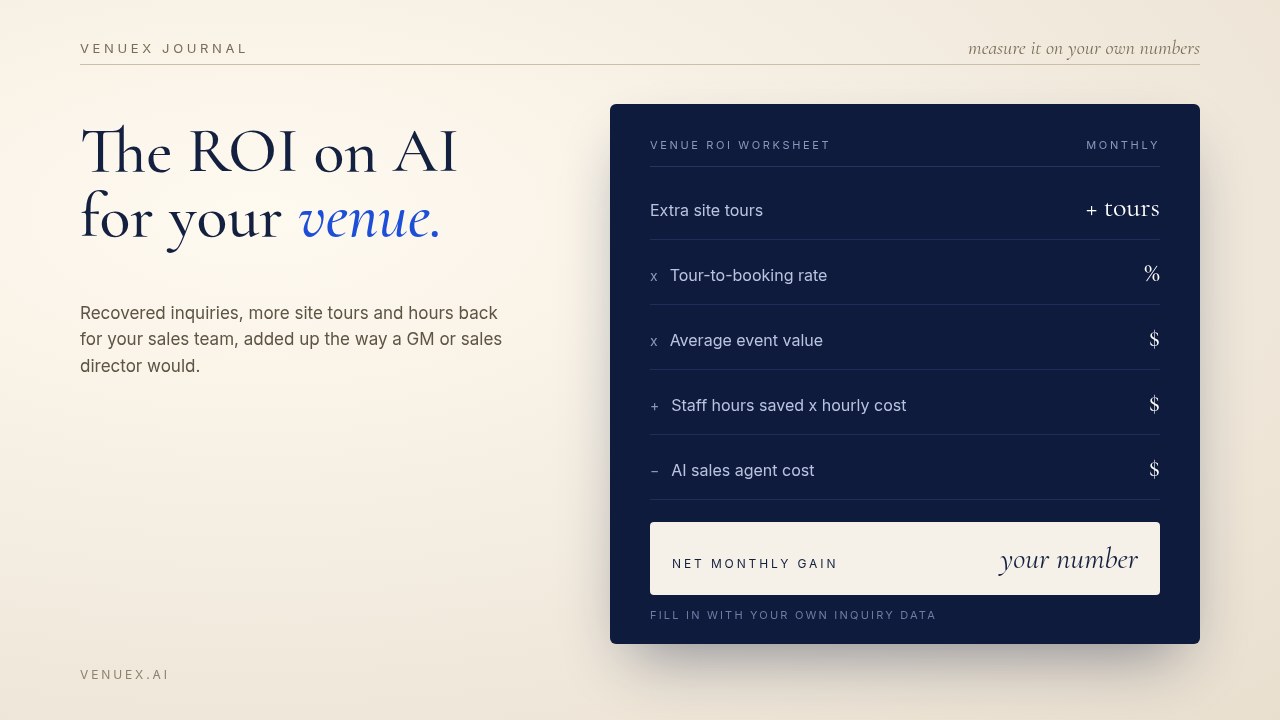
The ROI on AI for your venue comes from two places: new revenue from inquiries you would otherwise lose, and staff hours you get back. To calculate it, take the extra tours an AI sales agent books, multiply by your tour-to-booking rate and average event value, add the hours saved times your hourly labor cost, then subtract the cost of the software. For most event venues and hotels with event spaces, the biggest driver is not labor savings. It is speed and follow-up: answering every inquiry in seconds, 24/7, and following up until the lead books a tour. Here is a simple framework, a worked example and the KPIs to track so you can measure ROI on your own numbers.
The ROI on AI for your venue comes from two places: new revenue from inquiries you would otherwise lose, and staff hours you get back. To calculate it, take the extra tours an AI sales agent books, multiply by your tour-to-booking rate and average event value, add the hours saved times your hourly labor cost, then subtract the cost of the software. For most event venues and hotels with event spaces, the biggest driver is not labor savings. It is speed and follow-up: answering every inquiry in seconds, 24/7, and following up until the lead books a tour. Here is a simple framework, a worked example and the KPIs to track so you can measure ROI on your own numbers.
What "AI for your venue" actually means
When venue owners, GMs and sales directors ask about the ROI on AI, they usually mean an AI sales agent: software that answers every new inquiry from your website, email, text, The Knot, WeddingWire and Zola, answers questions from your real pricing and policies, qualifies the lead, books site tours on your calendar and follows up when leads go quiet. That is different from a simple website chatbot, which mostly captures contact details. If you are still deciding between the two, start with our breakdown of AI sales agents vs. chatbots.
An AI sales agent is also not a CRM. Your CRM, whether that is Tripleseat, HoneyBook, Event Temple or another system, stays your record for proposals, contracts and event details. The AI sales agent sits in front of it and does the first touches, so the ROI question is about what that layer adds.
The four places venue AI ROI comes from
Recovered revenue: Inquiries that would have gone cold because nobody replied fast enough, or nobody followed up after the first email.
More tours from the same leads: Faster replies and consistent follow-up move more inquiries to a booked site visit, without spending more on ads or marketplace listings.
Staff time: Hours your team spends answering repeat questions, chasing leads and scheduling tours, which can go back into tours, proposals and events.
After-hours coverage: Many couples and planners inquire at night and on weekends. A reply in seconds while they are still browsing beats a reply the next afternoon.
The first two are revenue gains. The last two show up as time and as a better lead experience, which also feeds revenue. Most venues should measure both, but lead with tours booked, because that is the clearest link to booked events.
How to calculate the ROI on AI for your venue
You do not need a complicated model. Use your own numbers from the last three months and work through these steps.
Count your inquiries. How many new leads arrive per month across all sources? How many got a reply later than an hour, or no follow-up after the first message?
Find your conversion rates. What share of inquiries book a tour, and what share of tours book an event? Your CRM reports usually have both.
Know your average event value. Use average booked revenue per event. Hotels should separate weddings, social events and corporate groups if values differ a lot.
Estimate the lift in tours. Pick a conservative assumption for how many more leads reach a tour when every inquiry gets an instant reply and steady follow-up. Start low, then replace the guess with real data after launch.
Estimate hours saved. How many hours a week does your team spend on first replies, repeat questions, follow-ups and tour scheduling? Multiply by a loaded hourly cost.
Subtract the cost. Take the subscription and any setup time away from the gains.
The formula: ROI = (extra tours x tour-to-booking rate x average event value) + (hours saved x hourly cost) - AI cost.
A worked example with illustrative numbers
The numbers below are an example only, not results from a VenueX customer. Swap in your own.
Inquiries: 100 new leads a month.
Lead-to-tour rate today: 20%, so 20 tours a month.
Tour-to-booking rate: 25%, so 5 booked events a month.
Average event value: $15,000.
Assumed lift: A conservative 10% more tours, or 2 extra tours a month.
Hours saved: 10 hours a week at $30 an hour, or about $1,300 a month.
In this example, 2 extra tours at a 25% booking rate is about one extra event every two months, or roughly $7,500 a month in added booked revenue on average, plus about $1,300 in staff time. Subtract the software cost and the result is the net monthly gain. The takeaway for most venues is simple: one or two extra bookings a year often decides whether the tool pays for itself, so the tour lift matters far more than the hours. If you are comparing AI with adding headcount instead, see AI sales agent vs. hiring a salesperson.
See it live
Want to see how VenueX can do this for your venue?
Book a demo and watch VenueX reply to inquiries in about 10 seconds, follow up, and book tours on your calendar, trained on your voice.
Only counting labor: Hours saved is real, but recovered bookings are usually the bigger number.
No baseline: Without before numbers, you cannot tell what the AI changed.
Judging too early: Venue sales cycles are long. Look at tours first, then bookings over a full cycle.
Ignoring lead sources: Check results by source, since marketplace leads from The Knot or WeddingWire often behave differently from website leads.
Weak handoffs: If the AI books a tour but nobody preps for it, the tour-to-booking rate drops.
How VenueX helps you capture the ROI
VenueX is an AI sales agent built for event venues and hotels with event spaces. It replies to new inquiries in about 10 seconds, 24/7, by email and SMS, and the same agent runs your website live chat. It answers from a knowledgebase your team approves and tests, qualifies leads, books tours on your connected calendar and follows up automatically. VenueX works alongside your CRM, with integrations for Tripleseat, HoneyBook and Event Temple, plus Gmail, Outlook and Google Calendar, and its analytics show response times, tours booked and lead activity so you can measure ROI on real data. See everything on our features page.
Want to see the numbers for your venue? Book a demo and we will walk through your inquiry volume, conversion rates and event values, then show VenueX handling your real inquiries. [Get started with VenueX](/getting-started) or compare plans on our [pricing page](/pricing).
Multiply the extra tours the AI books by your tour-to-booking rate and average event value, add hours saved times your hourly labor cost, then subtract the cost of the software. Use at least two to three months of data from before launch as your baseline.
How long does it take to see ROI from an AI sales agent?
Response time and follow-up coverage change as soon as the agent is live. Tours are the next signal, and bookings follow your normal sales cycle, so compare 60 to 90 days of results against your baseline before judging.
Which KPIs matter most for venue AI?
First response time, follow-up coverage beyond the first reply, inquiry-to-tour rate, tour-to-booking rate, tours booked by the AI and staff hours saved.
Is AI worth it for a hotel with event spaces?
Often, because hotels field wedding, social and corporate group inquiries at all hours alongside other guest requests. An AI sales agent replies instantly, qualifies each lead and books site visits, while your sales team handles proposals, room blocks and negotiations.
Does an AI sales agent replace my CRM or sales team?
No. VenueX is not a CRM and does not replace your team. It works alongside CRMs like Tripleseat, HoneyBook and Event Temple, handling first replies, follow-up and tour booking so your team can focus on tours and closing.
Get started
Want to see how VenueX can do this for your venue?
Book a demo and watch VenueX reply to inquiries in about 10 seconds, follow up, and book tours on your calendar, trained on your voice.