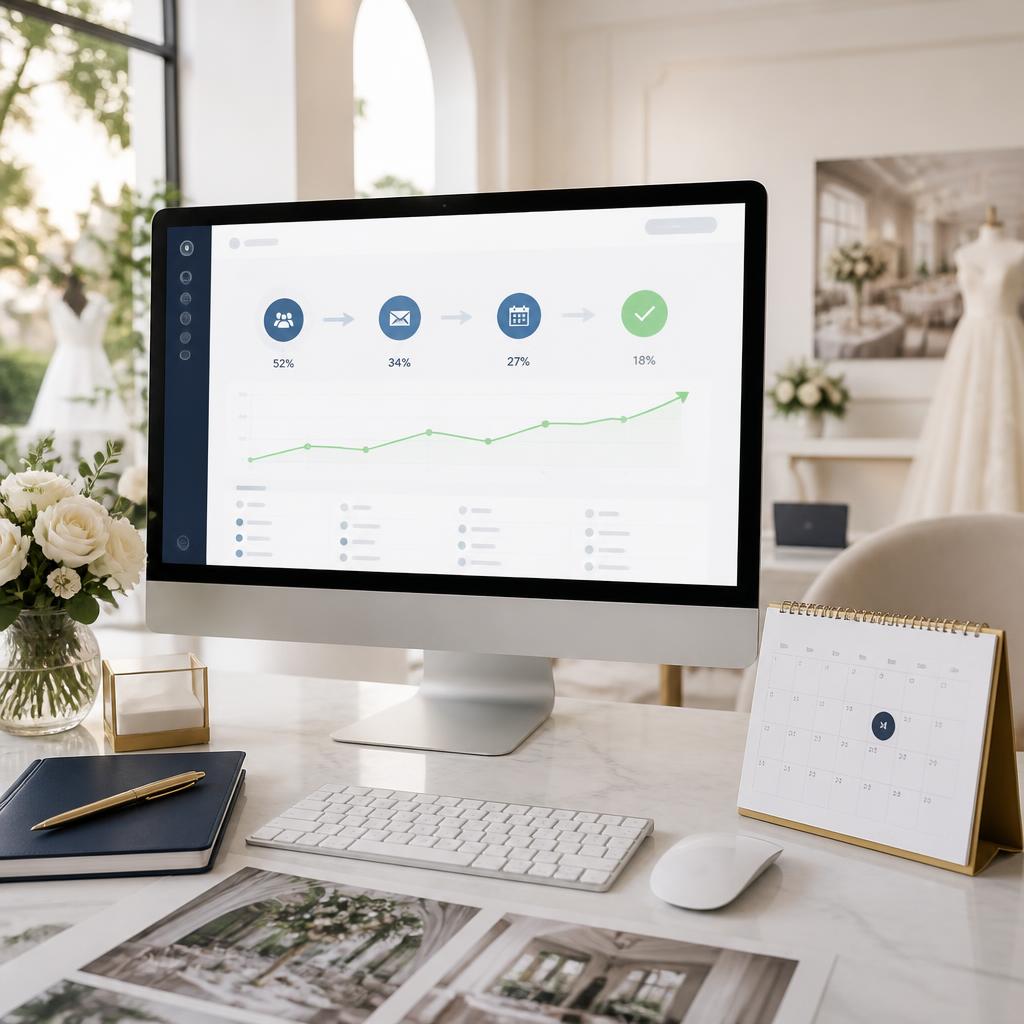
The Wedding Venue Sales Funnel: How to Turn More Inquiries Into Booked Events
Learn how the wedding venue sales funnel works from first website visit to inquiry, tour, and booked event, plus where venues commonly lose potential clients.
Abed Elsamna
A wedding venue sales funnel starts long before a couple schedules a tour. Venues have to generate demand, turn website visitors into inquiries, respond while interest is high, consistently follow up, schedule tours, and ultimately convert those tours into booked events. Improving even one stage of the funnel can create more bookings without necessarily increasing lead volume.
What is a wedding venue sales funnel?
A wedding venue sales funnel is the journey a potential client takes from discovering your venue to ultimately booking an event.
At a high level, it looks like this:
Discovery → Website Visit → Inquiry → Conversation → Qualified Lead → Tour → Proposal → Booked Event
Every step matters. And every transition represents an opportunity to lose a potential booking.
That's why looking only at total inquiries or total bookings doesn't tell you enough. If you want to grow venue revenue, you need to understand what happens between them.
Stage 1: Getting discovered
Before someone can inquire, they have to find you. Couples might discover a wedding venue through:
Google
Google Maps
Wedding directories
Social media
AI search tools
Referrals
Paid advertising
Venue listing websites
Historically, venues have focused heavily on traditional search engines and wedding directories. That's still important. But discovery is expanding. Potential clients are increasingly able to ask AI-powered search tools detailed questions about venues, locations, capacity, pricing, styles, and other preferences.
That means venues need to think beyond simply ranking for one keyword. Your website needs to clearly communicate what your venue offers in a way that both people and search engines can understand.
Stage 2: Turning website visitors into inquiries
Traffic alone doesn't create revenue. A wedding venue could attract thousands of visitors every month and still struggle if those visitors don't take the next step.
Your website needs to answer enough of the couple's questions to create interest while making it easy to inquire. That includes clearly communicating things like:
Location
Venue style
Capacity
Ceremony options
Important amenities
Photos
Frequently asked questions
What makes the venue different
How to take the next step
The inquiry form itself matters too. Ask enough questions to help your team start the conversation, but don't create unnecessary friction with an enormous form. The goal is to move an interested visitor into your sales process.
Stage 3: Responding while intent is high
Someone submits the inquiry. Now the clock starts. At that moment, they're actively researching venues. They may also be submitting forms on several other venue websites.
The first venues to start useful conversations have an opportunity to capture the couple's attention while their interest is still high. But this creates a difficult operational problem for venue teams. Inquiries don't conveniently arrive between 9 and 5. They arrive during weddings. At night. On weekends. While someone is giving another couple a tour.
Speed-to-lead matters, but staffing someone to watch the inbox around the clock isn't realistic for most venues. The sales process needs to account for that. A faster, more consistent response is exactly what an AI sales agent for venues and caterers is built to handle.
Stage 4: Turning the inquiry into a conversation
A response doesn't automatically mean you have a conversation. If your first message is a massive information dump and the couple never replies, the funnel stops.
The goal of the initial response should be to move the lead forward. Answer their questions. Acknowledge what they've already shared. Ask what's needed to qualify them. Then provide one logical next step. Every additional hurdle creates another opportunity for the lead to disappear. A strong wedding venue lead follow-up process makes this step repeatable instead of ad hoc.
Stage 5: Following up
This is one of the biggest leaks in the wedding venue sales funnel. A lead doesn't respond to the first email, so the salesperson plans to circle back. Then Saturday's wedding happens. More inquiries arrive. Monday gets busy. The lead gets pushed further down the inbox. Eventually, nobody follows up.
This is why follow-up needs to be a process rather than a task someone has to remember. Not every couple will respond immediately. Some need a reminder. Some need another question answered. Some simply need the conversation restarted at the right time. Consistent follow-up gives those leads another opportunity to move forward.
Stage 6: Converting qualified leads into tours
For many wedding venues, the tour is the most important conversion point in the sales funnel. Online research can create interest. Photos can show the property. Pricing information can help establish fit. But seeing the venue in person can turn an abstract option into a place where the couple can actually imagine their wedding happening.
That means one of the most important metrics a venue can track is inquiry-to-tour conversion rate. For example, if you receive 200 qualified inquiries and schedule 20 tours, your inquiry-to-tour rate is 10%. Increase that to 15%, and you're scheduling 30 tours from the same 200 inquiries. No additional lead generation required. That's why improving conversion can be just as important as increasing traffic.
Stage 7: Turning tours into booked events
Once the tour happens, the sales process changes. This is where the human side of venue sales becomes especially important. The couple has seen the space. They've met your team. They've started imagining the event. Now your team needs to help them make a decision.
Post-tour follow-up should be organized and timely. That might include answering remaining questions, sending proposals, clarifying packages, discussing available dates, and keeping the conversation moving until the couple makes a decision. The goal isn't to pressure them. It's to make sure an interested couple doesn't lose momentum after leaving the property. Tracking your tour-to-booking conversion reveals exactly where this stage leaks.
Measure every stage of the funnel
Imagine a venue receives 500 website visits. 50 visitors submit inquiries. 20 schedule tours. 5 ultimately book. That gives you several different conversion points to examine:
Website visitor → Inquiry: 10%
Inquiry → Tour: 40%
Tour → Booking: 25%
Inquiry → Booking: 10%
Now you can start asking better questions. What happens if website conversion improves? What happens if more inquiries schedule tours? What happens if the tour close rate increases? Instead of saying, "We need more leads," you can identify exactly where the funnel is underperforming. These are the same wedding venue sales KPIs that separate high-performing venues from the rest.
More leads aren't always the answer
Lead generation gets a lot of attention because it's easy to see. More website traffic. More inquiries. More form submissions. But increasing the top of the funnel doesn't fix problems further down.
If your team is already struggling to respond to 300 inquiries, generating another 100 may simply create another 100 opportunities for inconsistent follow-up. Sometimes the biggest growth opportunity is already sitting in your inbox. Before spending more money generating demand, understand how effectively you're converting the demand you already have.
Where AI fits into the wedding venue sales funnel
AI can support different stages of the funnel. Search and content tools can help venues identify opportunities to improve their visibility. Website optimization can help turn more visitors into inquiries. AI sales agents can respond to those inquiries, answer common questions, follow up, qualify leads, and help schedule tours.
That doesn't mean removing people from the process. It means deciding where people provide the most value. Your team is valuable when they're walking a couple through the venue. When they're building relationships. When they're navigating a unique request. When they're helping someone confidently make a major purchasing decision. Manually sending the fourth follow-up email to an inquiry that came in last week probably isn't where that same person provides the most value.
Building a wedding venue revenue engine
The most effective venue growth strategy connects the entire journey. It isn't: run SEO, generate leads, hope sales follows up. It's a connected system: get discovered → generate demand → capture the inquiry → respond → follow up → schedule the tour → close the event. Each stage feeds the next.
This is the idea behind the revenue engine VenueX is building for hospitality businesses. VenueX's AI Sales Agent focuses on the inquiry-to-tour portion of the funnel by responding to leads, continuing conversations, following up, and helping qualified prospects schedule tours. The broader goal is to connect the systems that generate demand with the systems that convert that demand into revenue. Because generating another inquiry doesn't matter much if nobody turns it into a conversation.
Start with your biggest funnel leak
You don't need to rebuild your entire sales and marketing operation overnight. Start by measuring what happens today. How many people visit your website? How many become inquiries? How many inquiries receive a response? How quickly? How many respond back? How many schedule tours? How many tours become bookings?
Once you know those numbers, your biggest opportunity usually becomes much easier to see. Maybe you need more demand. Maybe your website isn't converting. Maybe leads aren't being followed up with. Maybe too few inquiries become tours. Or maybe tours aren't closing. The important thing is knowing which problem you're actually solving.
See how VenueX can help turn more of your existing inquiries into tours and booked events. Request a demo today.
A wedding venue sales funnel is the process that takes a potential client from discovering the venue through inquiry, qualification, tour, proposal, and ultimately booking an event.
What is a good wedding venue inquiry-to-tour conversion rate?
There isn't one universal benchmark because venue type, pricing, lead sources, qualification criteria, and market can significantly affect conversion. The most useful approach is to establish your venue's current baseline and measure improvements over time.
How can wedding venues increase lead conversion?
Start with faster responses, better qualification, consistent follow-up, clear calls to action, easier tour scheduling, and measurement of conversion rates throughout the sales funnel.
What wedding venue sales metrics should I track?
At minimum, track inquiry volume, response time, lead response rate, inquiry-to-tour conversion, tour-to-booking conversion, and overall inquiry-to-booking conversion.
Can AI help wedding venues book more tours?
AI sales agents can help by responding to inquiries quickly, answering common questions, consistently following up, qualifying prospects, and making it easier for interested couples to schedule tours.
Get started
Want to see how VenueX can do this for your venue?
Book a 20-minute demo and watch the agent reply, follow up, and book tours on your calendar — trained on your voice.